Programming
Is there a way to detect if an image is blurry closed
Have you ever uploaded an image to your website or social media, only to realize later that it’s blurry? It’s a common frustration, especially when striving for a professional and visually appealing online presence. The question, “Is there a way to detect if an image is blurry?” is surprisingly complex, encompassing various techniques and algorithms. Ensuring image clarity is crucial for user experience, brand perception, and even search engine optimization. Blurry images can detract from your message and leave a negative impression. Fortunately, advancements in technology offer several methods to automatically assess image sharpness, helping you identify and replace substandard visuals before they impact your audience. This article delves into the science and practical application of blur detection, providing you with the knowledge to maintain high-quality images across your digital platforms. Poor quality images can impact website loading speed and overall SEO performance, so understanding blur detection is an important skill. We’ll explore different algorithms, tools, and strategies to help you ensure your images are crisp and clear.
Understanding Image Blur and Its Impact
Image blur, at its core, is a reduction in the sharpness and clarity of an image. This can occur due to various factors, including camera shake, incorrect focus, or even compression artifacts. The impact of blurry images extends far beyond mere aesthetics. In e-commerce, for example, blurry product photos can deter potential customers, leading to lost sales. A study by Baymard Institute found that 69.82% of online shopping carts are abandoned, and poor product images are a contributing factor [1]. In content marketing, blurry images can damage credibility and reduce engagement. Readers are less likely to trust content that appears unprofessional or poorly presented. Therefore, implementing strategies to detect and correct image blur is essential for maintaining a positive online presence and achieving business objectives.
Several types of blur exist, each requiring different detection and correction approaches. Gaussian blur, for instance, is a common type often used to smooth images or create artistic effects. Motion blur occurs when the camera or subject moves during the exposure. Out-of-focus blur arises when the subject is not within the camera’s focal plane. Understanding the type of blur present in an image can help you choose the most appropriate detection method. Advanced techniques, such as frequency domain analysis, can help identify specific types of blur by examining the image’s spectral characteristics.
Blur detection algorithms are especially useful in automated systems where manual inspection of every image is impractical. Consider a large image library where thousands of photos are uploaded daily. Manually checking each image for blur would be time-consuming and costly. Automated blur detection can flag potentially problematic images for review, saving time and resources. This is particularly important for platforms that rely heavily on user-generated content, such as social media sites and online marketplaces. These systems often employ sophisticated algorithms to ensure that only high-quality images are displayed to users, enhancing the overall user experience.
Methods for Detecting Image Blur
Several algorithms and techniques are available for detecting image blur. One common approach involves analyzing the image’s gradient magnitude. Images with sharp details tend to have high gradient magnitudes, while blurry images have lower values. The Laplacian variance method is another popular technique that measures the variance of the Laplacian of the image. This method is based on the principle that sharp images have a higher variance than blurry images. Another approach uses frequency domain analysis, where the image is transformed into the frequency domain using the Fourier transform. Blurry images typically have a lower amplitude in the high-frequency components, indicating a lack of fine details.
The Laplacian variance method, often implemented in image processing libraries like OpenCV, calculates the variance of the Laplacian of an image. Specifically, you convolve the image with a Laplacian operator, which highlights edges and sharp details. The variance of the resulting image is then computed. A high variance indicates a sharp image, while a low variance suggests blur. This method is computationally efficient and relatively easy to implement, making it a popular choice for real-time blur detection applications. However, it can be sensitive to noise and may require pre-processing steps to improve accuracy. The algorithm can be described with the following steps:
- Convert the image to grayscale.
- Apply a Laplacian filter to the image.
- Calculate the variance of the filtered image.
- Compare the variance to a threshold to determine if the image is blurry.
Featured Snippet Optimization: The Laplacian variance method is a common technique for detecting image blur. It calculates the variance of the Laplacian of an image, where a high variance indicates sharpness and a low variance suggests blur. This method is computationally efficient and easy to implement using libraries like OpenCV, making it a practical choice for real-time applications. The threshold value used to classify blur can be adjusted depending on the application and image characteristics.
Tools and Libraries for Blur Detection
Several software tools and libraries can be used to implement blur detection algorithms. OpenCV (Open Source Computer Vision Library) is a widely used library that provides a comprehensive set of functions for image processing and computer vision tasks [2]. OpenCV includes functions for calculating the Laplacian variance, gradient magnitude, and other metrics used in blur detection. Python, with its rich ecosystem of scientific computing libraries, is a popular choice for implementing blur detection algorithms. Libraries like NumPy and SciPy provide efficient numerical computation and signal processing capabilities.
Commercial software packages, such as Adobe Photoshop and MATLAB, also offer tools for assessing image sharpness. Photoshop’s “Sharpen” filters, for example, can be used to visually assess the level of blur in an image. MATLAB provides a wide range of image processing functions, including tools for calculating image quality metrics and implementing custom blur detection algorithms. These tools often provide a graphical user interface (GUI), making it easier for users to interact with the algorithms and visualize the results. For developers, cloud-based image analysis services, such as those offered by Amazon Web Services (AWS) and Google Cloud Platform (GCP), provide APIs for performing blur detection and other image processing tasks. These services can be easily integrated into existing applications, allowing developers to add blur detection capabilities without having to implement the algorithms from scratch.
Here are some key considerations when choosing a tool or library for blur detection:
- Ease of use: How easy is it to implement and use the tool or library?
- Performance: How fast and efficient is the algorithm?
- Accuracy: How accurately does the algorithm detect blur?
- Cost: What is the cost of using the tool or library?
Blur detection has numerous practical applications across various industries. In photography, it can be used to automatically filter out blurry images during post-processing, saving photographers time and effort. In quality control, blur detection can be used to ensure that manufactured products are visually inspected with sufficient clarity. For example, a manufacturing plant might use cameras to inspect products on an assembly line. If an image is blurry, the system can automatically flag the product for further inspection. In security and surveillance, blur detection can be used to identify potentially compromised video footage. A sudden increase in blurriness might indicate that the camera has been tampered with or that the environment has changed.
E-commerce platforms can leverage blur detection to ensure that product images meet a minimum quality standard. Before displaying an image to customers, the platform can automatically check for blur and reject images that do not meet the required sharpness threshold. This helps improve the overall shopping experience and increase customer satisfaction. For instance, an online clothing retailer could use blur detection to verify that the details of the fabric and stitching are clearly visible in product images. This ensures that customers can accurately assess the quality of the clothing before making a purchase. You can use blur detection algorithms to improve website SEO.
Here are some additional examples of how blur detection can be applied:
- Automatically rejecting blurry photos during photo booth events.
- Filtering out blurry frames in video surveillance systems.
- Improving the quality of medical images for diagnosis.
- Enhancing the clarity of satellite images for remote sensing.
FAQ: Frequently Asked Questions
- What is the best method for detecting image blur?
- The best method depends on the specific application and image characteristics. The Laplacian variance method is a good starting point, but other techniques, such as frequency domain analysis, may be more suitable for certain types of blur.
- How can I improve the accuracy of blur detection algorithms?
- Pre-processing steps, such as noise reduction and contrast enhancement, can help improve accuracy. Additionally, adjusting the threshold values used to classify blur can fine-tune the algorithm's performance.
- Are there any limitations to blur detection algorithms?
- Yes, blur detection algorithms can be sensitive to noise, lighting conditions, and other factors. They may also struggle to detect subtle forms of blur or blur that is intentionally introduced for artistic purposes.
- Can blur detection be used in real-time applications?
- Yes, many blur detection algorithms are computationally efficient enough to be used in real-time applications, such as video surveillance and automated quality control.
Another very simple way to estimate the sharpness of an image is to use a Laplace (or LoG) filter and simply pick the maximum value. Using a robust measure like a 99.9% quantile is probably better if you expect noise (i.e. picking the Nth-highest contrast instead of the highest contrast.) If you expect varying image brightness, you should also include a preprocessing step to normalize image brightness/contrast (e.g. histogram equalization).
I’ve implemented Simon’s suggestion and this one in Mathematica, and tried it on a few test images:

The first test blurs the test images using a Gaussian filter with a varying kernel size, then calculates the FFT of the blurred image and takes the average of the 90% highest frequencies:
testFft[img_] := Table[ ( blurred = GaussianFilter[img, r]; fft = Fourier[ImageData[blurred]]; {w, h} = Dimensions[fft]; windowSize = Round[w/2.1]; Mean[Flatten[(Abs[ fft[[w/2 - windowSize ;; w/2 + windowSize, h/2 - windowSize ;; h/2 + windowSize]]])]] ), {r, 0, 10, 0.5}]
Result in a logarithmic plot:
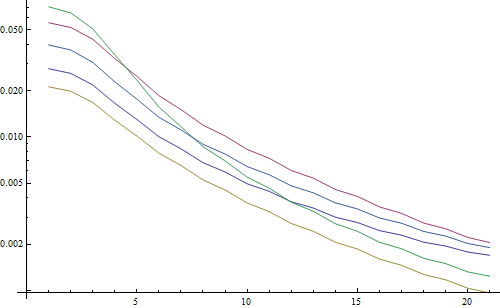
The 5 lines represent the 5 test images, the X axis represents the Gaussian filter radius. The graphs are decreasing, so the FFT is a good measure for sharpness.
This is the code for the “highest LoG” blurriness estimator: It simply applies an LoG filter and returns the brightest pixel in the filter result:
testLaplacian[img_] := Table[ ( blurred = GaussianFilter[img, r]; Max[Flatten[ImageData[LaplacianGaussianFilter[blurred, 1]]]]; ), {r, 0, 10, 0.5}]
Result in a logarithmic plot:
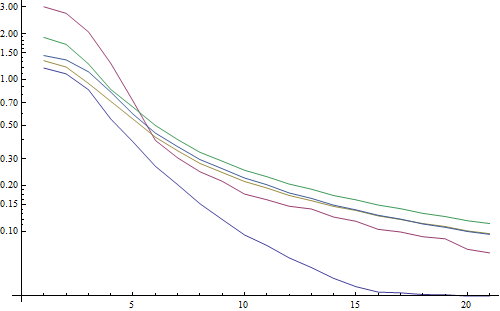
The spread for the un-blurred images is a little better here (2.5 vs 3.3), mainly because this method only uses the strongest contrast in the image, while the FFT is essentially a mean over the whole image. The functions are also decreasing faster, so it might be easier to set a “blurry” threshold.
